Cantonese
My adopted language is Cantonese. Cantonese is a dialect of the Yue branch of Sinitic languages, but for the purposes of this project I will be refering to the entire language as Cantonese and treating it as a standalone language.
Table of Contents
- Geographic Distribution
- Number of Speakers
- Samples of Spoken Language
- Phonetic Inventory
- Consonant Sounds Comparison
- Vowel Sounds Comparison
- Recording Consonant Sounds
- Recording Words
Geographic Distribution
Cantonese is spoken in and around Southern China, namely in Guangzhou, Guangxi, Hong Kong, and Macau. There are significant Cantonese-speaking populations throughout Southeast Asia and in the United States, Canada, the United Kingdom, and Australia.
Number of Speakers
Cantonese has 86 million native speakers, making it 9th in the world in this regard. It has about one million non-native speakers, making the combined total 87 million speakers. It is the 21st most spoken language in the world.
Samples of Spoken Language
A street interview In Hong Kong produced for language learners.
A recent popular Cantonese song.
Phonetic Inventory
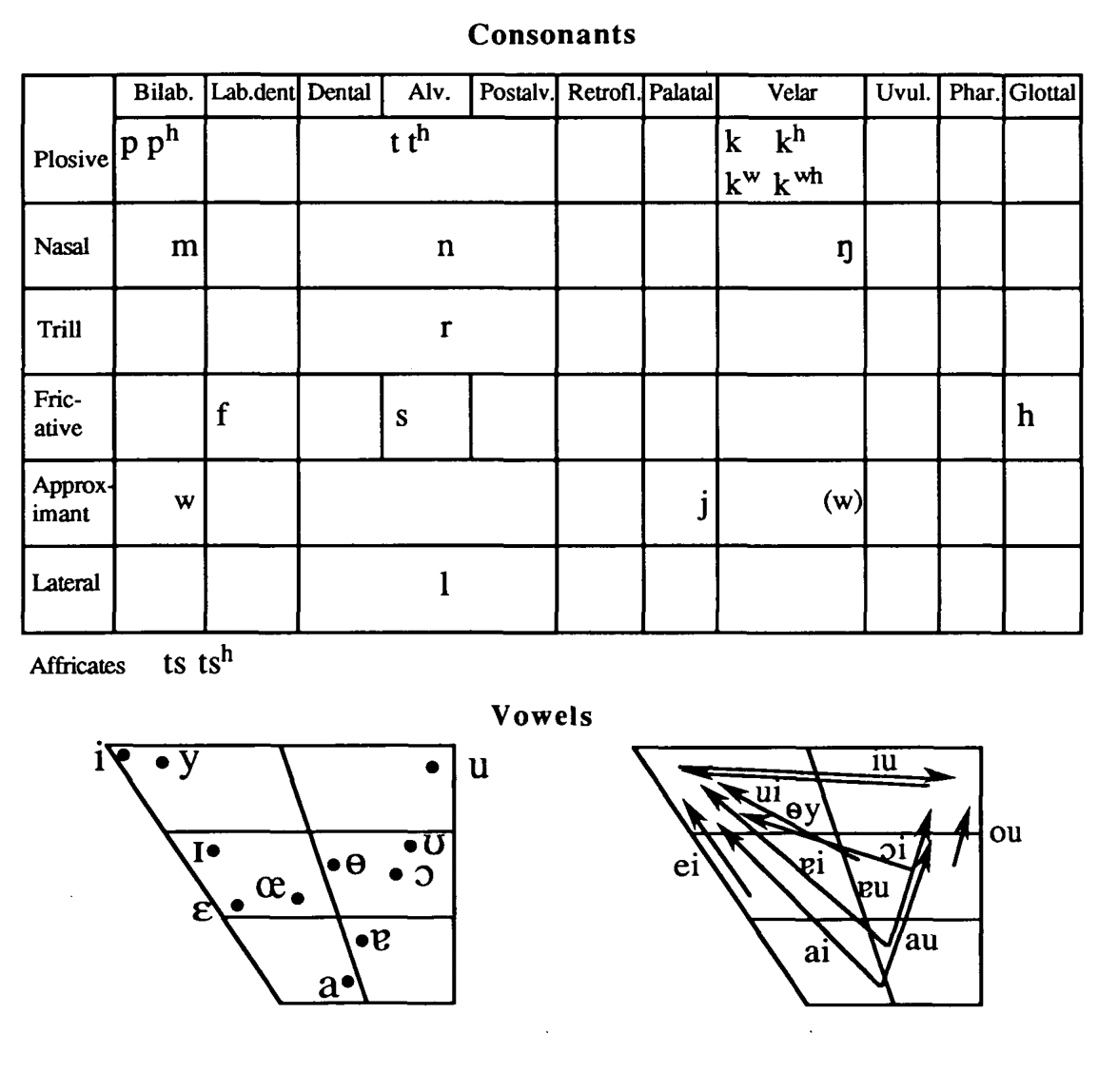 Image adapted from: Zee, Eric. 1999. Chinese (Hong Kong Cantonese). In Handbook of the International Phonetic Association, 58-60. Cambridge: Cambridge University Press.
An interactive phonetic inventory can also be found on Phoible.
Consonant Sounds Comparison
Found in Cantonese but not English
- [pʰ]*
- [tʰ]*
- [kʰ]*
- [kʷ]
- [kʷʰ]
- [t͡s]
- [t͡sʰ]
*These sounds occur allophonically with their un-aspirated counterparts in English, but in Cantonese they contrast.
Found in English but not Cantonese
- [t͡ʃ]
- [d]
- [d͡ʒ]
- [ɡ]
- [θ]
- [ʃ]
- [v]
- [ð]
- [z]
- [ʒ]
- [r]
Vowel Sounds Comparison
Cantonese has 11 vowels plus 11 diphthongs. Cantonese also assigns one of 6 or 9 tones to its vowels, meaning that there are over 100 unique vowel sounds possible per syllable.
Found in Cantonese but not English
- [y]
- [ɵ]
- [œ]
- [ɐ]
Found in English but not Cantonese
- [ɪ]
- [ʊ]
- [eɪ]
- [ə]
- [ʌ]
- [æ]
Recording Consonant Sounds
<kw> [kʷʰ]
<c> [t͡sʰ]
Recording Words
<caang2> meaning “orange”
[t͡sʰ]
<kai1> meaning “stream”
[kʰɐi]