Creole Language Exploration
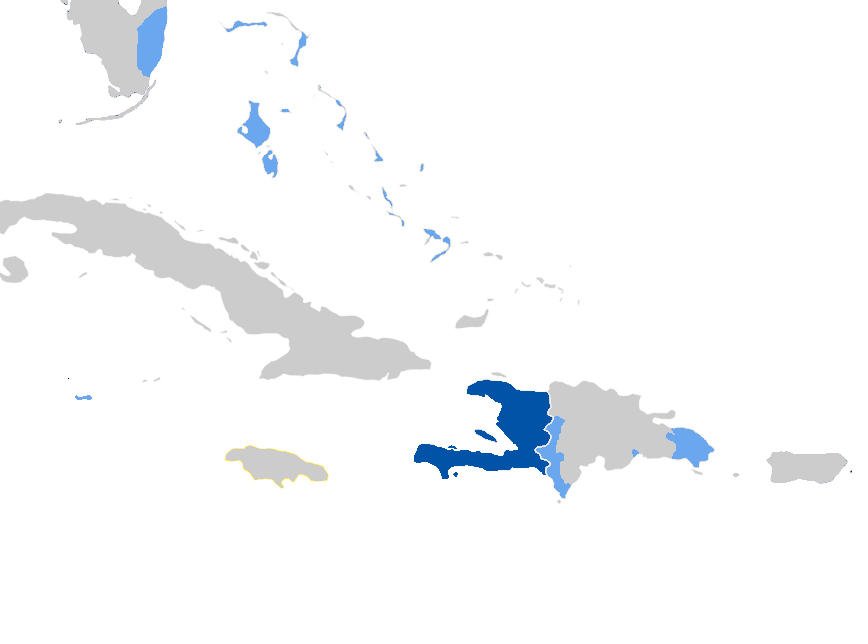
Map of where Haitian Creole is spoken. From Fobos92 at Wikimedia Commons.

Haitian Creole
Haitian Creole is the most widely spoken creole language on Earth, with more than 10 million speakers. It is mostly spoken in the Carribean country of Haiti, though it is also spoken by Haitian immigrant communities in neighboring islands, France, Canada, and the U.S. Around 90% of its vocabulary comes from French, but its grammar is similar to that of West African languages like Fon.
The French colony of Saint-Domingue was established in 1697 on the eastern part of the island of Hispaniola, with the western part being controlled by the Spanish. The French colonialists used African slaves to grow crops such as sugar cane, tobacco, and coffee. These slaves spoke various West African languages, particularly Kwa and the Gbe language group. Contact with other European colonists brought slight influences from Spanish, Portuguese, and English, and the native Taino language has had some influence as well.
Haiti gained its independence in 1804, but French continued to be the official language of the government, newspapers, and schools. Haitian Creole was seen until recently as an inferior or corrupted form of French. It was not until 1987 when Haitian Creole became a national language of Haiti and became more accepted.
Speaker Examples
WIKITONGUES: Margaret speaking Haitian Creole
Bad Boys Scene in Creole
Resources
Haitian Creole at Ethnologue:
https://www.ethnologue.com/language/hat/
“Haitian Creole - The World’s Most Widely Spoken Creole Language” by Langfocus on Youtube:
https://youtu.be/8IuQCyIdePE
“French in France vs Haitian Creole” by Lifey on Youtube:
https://youtu.be/KmYLdIW_KKI