The Sino-Tibetan Language Family
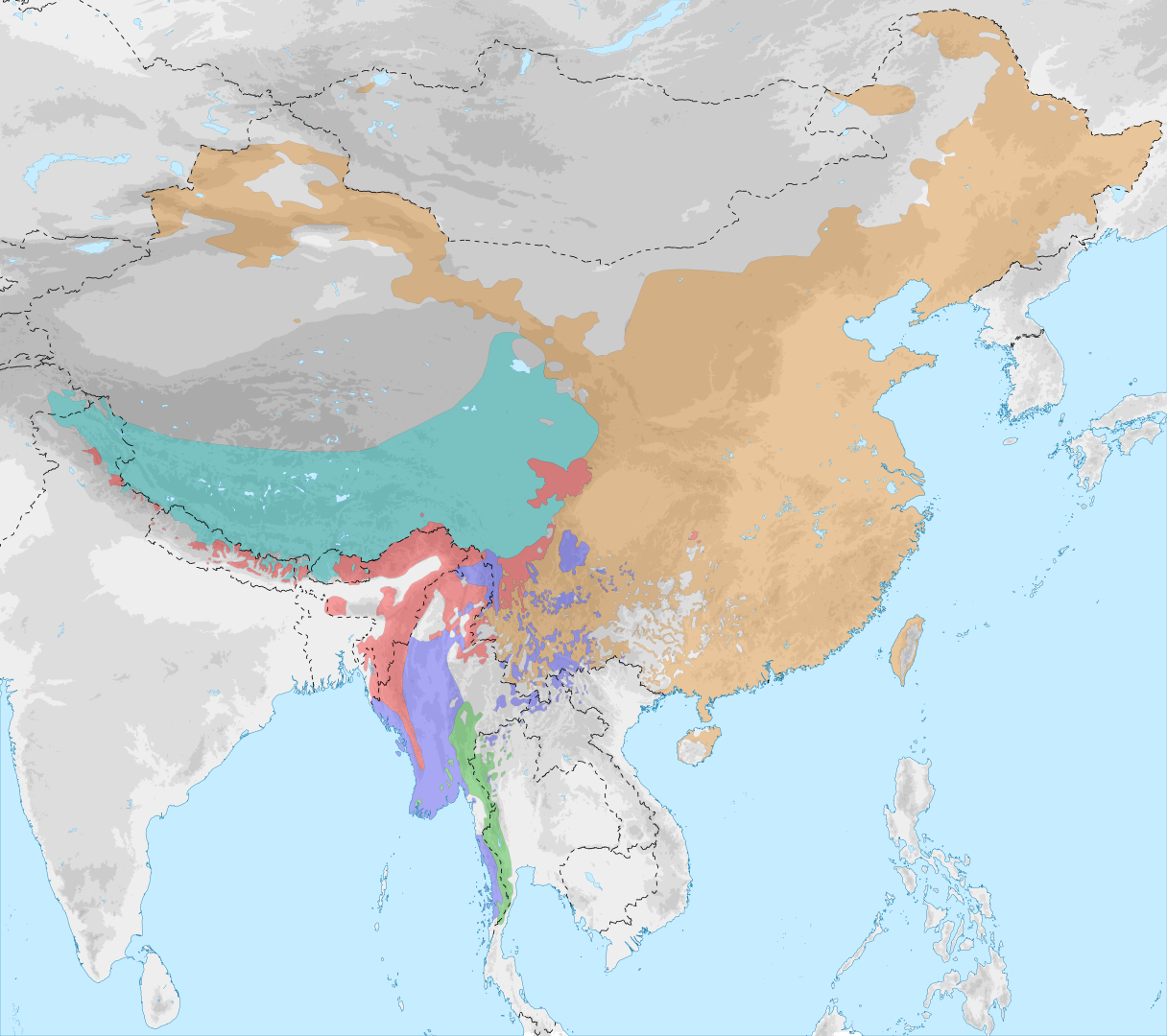
Distribution of major Sino-Tibetan language groups. From Kanguole, Wikimedia Commons.
Orange: Sinitic (94.3% of speakers). Purple: Lolo–Burmese (3.4%). Blue: Tibetic (0.4%). Green: Karenic (0.3%). Red: others (1.6%).

Sino-Tibetan
The Sino-Tibetan language group contains 458* languages in 100 subgroups. This makes it the fourth* largest language group accorging to Ethnologue, behind Trans-New Guinea (481), Austronesian (1256), and Niger-Congo (1552). By number of speakers it is second only to Indo-European, but the vast majority of its speakers come from a handful of Sinitic languages. In fact Mandarin Chinese alone makes up more than 90% of the ~1.4 billion total speakers of Sino-Tibetan languages.
Due to its diversity and the relative lack of research, it is hard to be sure about almost anything related to the Sino-Tibetan language family. There is not a reconstructed protolanguage, so its high-level structure is still unclear. The time depth of the language group is also uncertain, and there are multiple competing theories about its place of origin. Because many of these languages are spoken in unfriendly places like isolated mountainous areas or international border zones, it is difficult to study them.
*Note: Glottolog has different language counts than Ethnologue. It also places Indo-European (586) above Sino-Tibetan (514) in terms of total child languages.
Visualization
I have visualized the Sino-Tibetan Language family at the following page. You can pan and zoom as well as hover and click on languages and groups for more information.