Proto-Indo-European Cognates
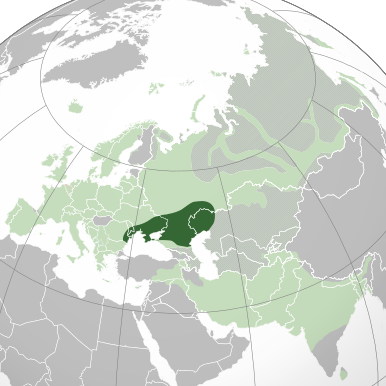
The Proto-Indo-European homeland according to the steppe hypothesis (dark green) and the present distribution of Indo-European languages in Eurasia (light green). Cropped, from Joe Roe, Wikimedia Commons.

Proto-Indo-European
The Indo-European language group consists of over 450 diverse languages spanning across Eurasia. Examples include Italian, Greek, Irish, Hindi, Spanish, German, Russian, and of course, English. It is the most spoken language group by far, with over 3.3 billion speakers worldwide.
The idea of an Indo-European language group was most famously put forward by William Jones in 1786 when he noticed similarities between the vocabulary and grammar of Sanskrit and those of Greek and Latin. He was not the first, but his work was the most influential in establishing the idea of a common proto-language. Since then, historical and comparative linguists have largely reconstructed an estimate of the Proto-Indo-European language and have worked out approximate timelines of the divergence of each language, though much debate still occurs in both areas.
Swadesh List
The Swadesh list, named for creator Morris Swadesh, is a list of basic words used in comparative linguistics. There are multiple versions of this list, ranging from 100 to over 200 words. Words were chosen for the list because of their universality and cultural independence, so that any given language should have nearly every word. By getting translations of these concepts in multiple languages and comparing them, linguists can determine how related those languages are and attempt to date their divergence.
Cognates
The following is a sample of words from the Swadesh List in a variety of Indo-European languages.
| English | Rom- anian | Scottish Gaelic | Lithu- anian | Ukra- inian | Bengali | Urdu |
|---|---|---|---|---|---|---|
| three | trei | trì | trys | три try |
তিন tina |
تین tin |
| snake | şarpe | nathair | gyvatė | змія zmiya |
সাপ sāpa |
سانپ sanp |
| nose | nas | sròn | nosies | ніс nis |
নাক nāka |
ناک naak |
| to see | vedea | fhaicinn | žr | бачити bachyty |
দেখা dēkhā |
دیکھیں dekhen |
| to fall | cădea | tuiteam | kristi | падати padaty |
পড়া paṛā |
گرنا garna |
| lake | lac | loch | ežeras | озеро ozero |
হ্রদ hrada |
جھیل jhel |
| year | an | bliadhna | metų | рік rik |
বছর bachara |
سال sal |
Three
It seems that every language on this list has a cognate of the English “three.” they all include the [t] followed by an [i], and most include the [r] as well. English, of course, uses the [θ] here instead of [t] due to Grimm’s Law
Snake
Romanian, Bengali, and Urdu all have [s], then [a], then [p]. These are likely cognates with the English “serpent,” through probably not “snake.”
Nose
Languages here with likely cognates of the English “nose” are Romanian, Lituanian, and possibly Bengali and Urdu. All of their translations start with [n], and the Romanian and Lithuanian both have the [s] like in English.
See
The only word that could reasonably be cognate the english “see” is the Lithuanian “žr,” pronounced like “zher.” The Romanian “vedea” is clearly related to English words like “vision,” though, and the Bengali and Urdu words seem to be very close cognates.
Fall
None of the languages here have words cognate with English “fall,” but interestingly it seems that the Ukrainian and Bengali words may be cognates. They both start with [p] and [a], and the Bengali “ṛ” is pronounced somewhat similarly to a [d].
Lake
The English “lake” is an obvious cognate of Romanian “lac” and Scottish Gaelic “loch.” The Lithuanian and Ukrainian words seem related too, as they both include a vowel followed by [z]/[ʒ] then [e] then [r]/[ɾ].
Year
Interestingly, none of the words in this row seem to be cognate with each other. Romanian “an” is related to English words like “annual,” though.